The globalisation of K-pop has influenced fans and the overall audience in many economies across the world. K-pop groups like BTS, ATEEZ, BlackPink, and more have made their name in the global music industry. Many times, K-pop songs topped the Billboard charts and ranked on Apple iTunes for the sake of their music and vocals. Moreover, the coming of YouTube has revolutionised the K-pop idols and groups’ image by making them accessible to a wider audience. Today, K-pop does not just deliver music but sells a way of life to its consumers and fans. Everyone wants to be like K-pop idols someday and travel wherever they go for a glimpse of them.
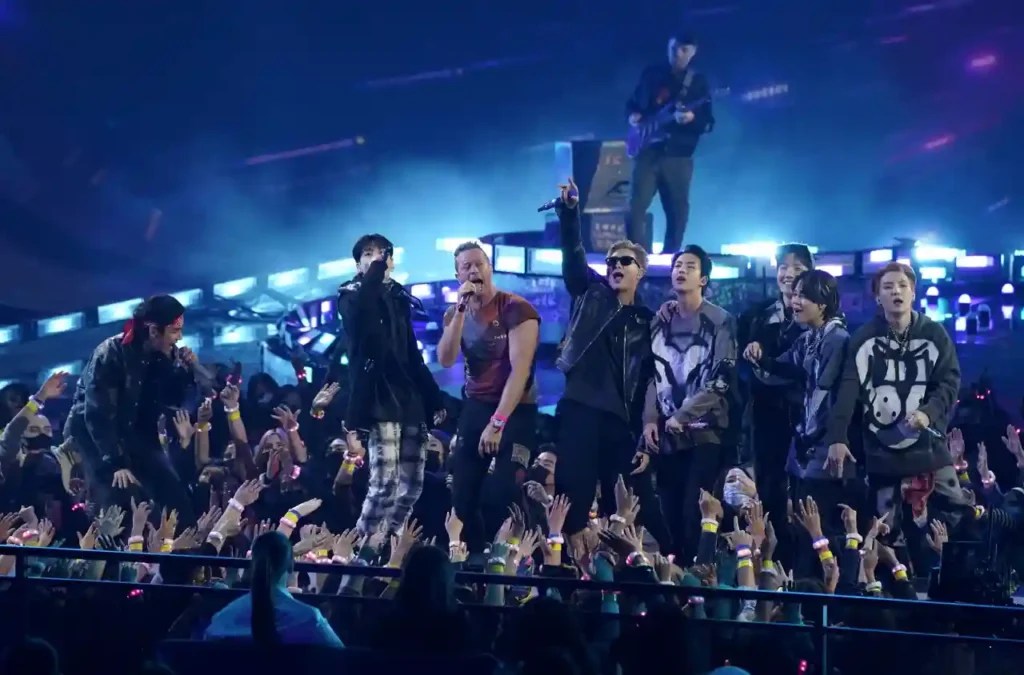
Table of Contents
What is the Globalisation of K-pop?
The globalisation of K-pop generally means the global influence of Korean music through sales, concerts, music, drama, people, and more. Through globalisation, Korean popular music adds value to the international music industry, integrates with different cultures and genres, contributes to the global economy, and further establishes connections by way of soft power. A few years ago, no one had ever think of K-pop idols would perform on the global stages, collaborate with popular artists, and participate in neck-to-neck competition on billboards. However, now K-pop’s success at the global level is inevitable, whether you remember BTS’s performance at the AMA or Blackpink’s Rose collaboration with Bruno Mars for APT, both point towards the globalisation of K-pop.
Historically, K-pop has been developed as part of the Korean culture. As it rose in popularity, it incorporated global music genres like R&B, Hip-Hop, Rock, Jazz, and Gospel in addition to its traditional musical roots. Thereafter, the development of K-pop led to the spread of the Korean Wave in countries like China, Hong Kong, Vietnam, first, then to neighbourhoods, and eventually to distant locations in the West. Currently, K-pop has massive fan bases in North America, Asia, and Europe. For instance, ARMY denotes the global fan base for the trendy K-pop boy band BTS.
For You: The Industrial System of K-Pop: How Idol Training Shapes Global Stars
Korean Wave (Hallyu)
The Korean Wave, also known as Hallyu, is a soft power phenomenon driven by the cultural exports of music, K-dramas, fashion, merchandise, and more. The rise and spread of the Korean wave is not limited to organic growth, but represents the cultural globalisation through strategic industries and moves. At the core, K-pop is considered to be a global product following the globalisation-localisation-globalisation processes.
Evolution of the Korean Wave
- K-pop Emergence at the Regional Level: The period between 1997 and 2000 marked the arrival of the Korean Wave in overseas countries. K-dramas like “What is Love” garnered immense popularity in China due to their portrayal of a free and libertarian way of life, which China lacked at that time. The Korean music also took centre stage following the success of K-dramas in China and Taiwan.
- The famous K-pop group H.O.T. performed in China for the first time in February 2000, and the Chinese used the term “Korean Wave” for the first time. All this was a result of K-pop infrastructure and social media. In the 1990s, Korean agencies began establishing their presence, while NRG gathered teenagers and adult K-pop fans through the social networking site Facebook. This phase marked the initial cultural diffusion.
- The famous K-pop group H.O.T. performed in China for the first time in February 2000, and the Chinese used the term “Korean Wave” for the first time. All this was a result of K-pop infrastructure and social media. In the 1990s, Korean agencies began establishing their presence, while NRG gathered teenagers and adult K-pop fans through the social networking site Facebook. This phase marked the initial cultural diffusion.
- Expansion in Asia: In this phase, Korean Pop or K-pop got its identity as Korean pop culture domestically and internationally. The phase was known for its spread of Korean dramas along with decent development of music. K-pop idol Rain became well-known internationally through her performances across the world.
- Tapping the Global Markets: Arrival of YouTube boosted or, in a way, established the global image of K-pop groups and idols. K-pop groups like BigBang, T-ARA, BTS, EXO, SHINee, Wonder Girls, Girls’ Generation began to be recognised by the mid 2000s, accelerating the craze of the Korean wave.
Rise of K-pop in the Global Market
The globalisation of K-pop has not happened overnight, but it has been a constant churning of events, strategies, and unique music. Much of the credit for global success goes to K-pop idols as well as their music agencies, who employ each and every strategy and technique to make it happen and trend over global charts. Here are some possible reasons we can think of when discussing the rise of K-pop music in the global markets.
- Global Marketing Strategy: The K-pop music agency owners are said to have learned from the global marketing strategies undertaken by foreign media houses and individual creators. Such strategies include collaborations, connections, creating buzz before the launch, and serving fresh and something new to the table. Due to such efforts and thorough market research, BTS became the first K-pop act to hit No. 1 on the US Billboard Hot 100 charts.
- Songs in Multiple Languages: This is quite a smart move from the producers of K-pop music. Since K-pop songs are primarily in the Korean language, it limits the virality of the songs and hurts the overall popularity and views. To solve this, music producers made the main vocals in the English language while the rest of the song remains in Korean. This experiment gave a massive boost to songs like Dynamite, Mic Drop, Fake Love, Ice Cream, and more.
- Fan Communities: We have to admit that K-pop producers have utilised social media smartly and integrated it with marketing strategy to boost the overall performance of K-pop acts across the world. What they did is, they formed social media-led fan communities that support and appear for the group whenever possible. For instance, BTS donated $1million for Black Lives Matter, replicating this, ARMY added $1million more donation within 24 hours for the same.
- K-pop Trainee System: The K-pop trainee system has been inducting potential trainees from across the world, making the K-pop industry more diverse and welcoming. Moreover, the trainee system teaches idols to be perfect for the market, training them on vocals, dance, handling controversies, showing effortless charisma and attitude, and more, which closely resonates with the audience.
For You: Min Hee Jin vs ADOR: All Details, Explanations, And More
Theories Responsible for the Globalisation of K-pop
Cultural Hybridity or Pop-Asianism
The Pop-Asianism or Cultural Hybridity theories see Asian culture as one big thing consisting of Japanese, Chinese, and Korean cultures together and interconnected, not apart. As per the theory, K-pop is not a sudden happening but is deeply rooted in broader Asian culture. Therefore, it is Asian Culture (AC) competing with Western Culture on the global stage.
According to the theory, K-pop is largely borrowed from several sub-branches of broader Asian culture to fill the void and compete with the Western music industry. It is a blend of cute aesthetics, style, vocals, and concepts across Asian countries. Therefore, K-pop is not an independent cultural phenomenon which came and challenged Western dominance, rather it was an offshoot of asian culture that emerged after liberalisation.
Global-Local-Global Theory
The Global-Local-Global Model, or Globalisation-Localisation-Globalisation theory, focuses on finding inspiration from global markets, which is then reproduced in the Korean culture and exported across the world. Basically, the theory accuses K-pop of copying Western ideas and presenting them as its own in the market. For instance, Girls’ Generation collaborate with global music producers and songwriters to add a Western touch to their albums, but maintains their Korean appeal intact with style and aesthetics.
Moreover, popular Korean music agency SM Entertainment sources global talent through a trainee system and audition, then Koreanizes them, and exports the music across the world. This theory explains the reasons for Korean dominance, or neck-to-neck competition with the Western music industry, but we find it somewhat biased.
For You: Why Girl Groups Are Dominating K-pop’s New Era (2023-2026)
Global Division of Labour Theory
The global division of labour theory stresses the fact that K-pop is the result of a production chain divided across countries. This basically means a K-pop song is composed in Europe, produced in the USA, styled in Korea, and distributed through online media networks for free. Therefore, the song is produced through diverse labour, then packed and delivered as K-pop to the fans and audience.
For instance, BlackPink songs are inspired by Western EDM and rap music, with a Korean style and aesthetics and distributed globally via YouTube. Another example is PSY’s Gangnam Style, which shook the Western market with a storm, was originally inspired by Western electronic music, served with slight Korean humour and dance moves.
Capitalist Production Theory
Have you ever watched any dance auditions or talent acquisition drives? This is what Korean music agencies like SM Entertainment and YG Entertainment do. They audition aspiring talent from the streets, pick idols from survival shows, and existing trainees from trainee camps, then soft launch them in precisely made K-pop groups with well-calculated members, personalities, aesthetics, and branding to make profits.
ADOR’s NewJeans can be one of the prime examples to explain capitalist production theory. Min Hee Jin cherry-picked talent from the USA, Australia, and Korea and joined them under one group with appealing branding and voice. The group hit the global charts in a couple of months after its debut and rose to global appreciation.
For You: Jang Yoon-ju shared the harsh reality of the Korean Modelling Industry these days
World Systems Theory
The world is divided into three systems: periphery, semi-periphery, and core world, where Western music lies in the core world, while the peripheral world consists of Asian music. As the theory argues, Korean music fills the void between Western and Asian culture and falls in the semi-pheripheral world due to its aesthetic and voice artists. Thereby, K-pop is entering both the markets, ranking on the Western global charts and influencing fans in the asian countries of China, Japan, and more.
The K-pop groups like BTS, ATEEZ, SEVENTEEN, BlackPink, Red Velvet, and more are equally famous in Western countries as they are in Asian countries. K-pop groups have their fanbases in each region and country, appealing to the social capital.
How K-pop Has Proved as a Reliable Soft Power for South Korea?
After the fall of Park Chung Hee, the primary focus of the government was shifted to the entertainment industry following the success of the movie “Jurassic Park.” President Kim Young-sam was shocked by the fact that Jurassic Park made equal ot 1.5 million Hyundai cars in monetary terms. The Ministry of Culture, Tourism, and Sports was restructured and enacted the Film Production law in 1996 to kickstart the entertainment industry.
Later, President Kim Dae-jung poured energy into globalising the Korean culture and solved the social and economic problems hindering the growth. Moreover, Netflix invested $1 billion in K-dramas in 2019, and South Korean series like Squid Game have topped the Netflix charts and remained one of the highest-grossing web series of all time. According to researcher Dal Young-jin, this soft power is actively wielded by the South Korean government in negotiations, global influence, and asserting choices. For instance, BTS has performed and spoken multiple times at the United Nations in 2018, 2020, and 2021.
Other instances are when Red Velvet performed in North Korea during a diplomatic thaw in 2018, BlackPink and Seventeen members ruling as brand ambassadors for global brands like Chanel, Dior, Louis Vuitton, and more. Gangnam Style is ruling the hearts of people across the globe to date. South Korean music and drama have increased tourism in the country and made fan communities in multiple countries closely watch every development in the nation.
For You: NewJeans Hope for Reunion Belied as ADOR Files Lawsuit Against NJZ Danielle
Current Status of the Korean Globalisation
At present, Korean culture has entered the hearts of the Gen Z; people are liking the Korean way of life, following their favourite K-pop idol and even want to join the forces someday. From hero worship to ” How can I join the K-pop trainee system?” Questions are changed, and so is the attitude of the South Korean agencies and government. The music agencies are looking for talent beyond the predominant Korean market to strengthen the global image of the K-pop industry. Korean Globalisation is on a rising streak and will increase in the future as well, as per current statistics.
Frequently Asked Questions
How has globalisation affected Korea?
Globalisation has increased the South Korean GDP, making it one of the fastest-growing GDPs in the world. Moreover, it has secured a safe spot in the world economy by way of its entertainment industry.
How does K-pop’s global reach affect its Korean identity?
The rise of K-pop has made Korean identity more attractive to people living outside the country. Today, many of them want to be like the Korean superstars, follow their lifestyle, skin care routines, K-fashion, and want to live in South Korea.
What is the global impact of K-pop?
K-pop has influenced the global music industry by fusing popular genres like Hip-Hop, Rock, R&B, and Rap with the K-pop music endeavours. However, BTS claimed K-pop to be a distinct music genre in the global music industry.
What factors explain the global popularity of K-pop?
The reasons which explain the global popularity of K-pop are the K-pop trainee system, dance skills of the K-pop idols, effortless confidence and charismatic personality, music fusion, attractive vocals, production and marketing by the music agencies.
How does K-pop create a sense of global community?
The sense of global community has been enforced by K-pop through its global tours, memberships, and fan communities to which fans subscribe and follow religiously without any questions.